


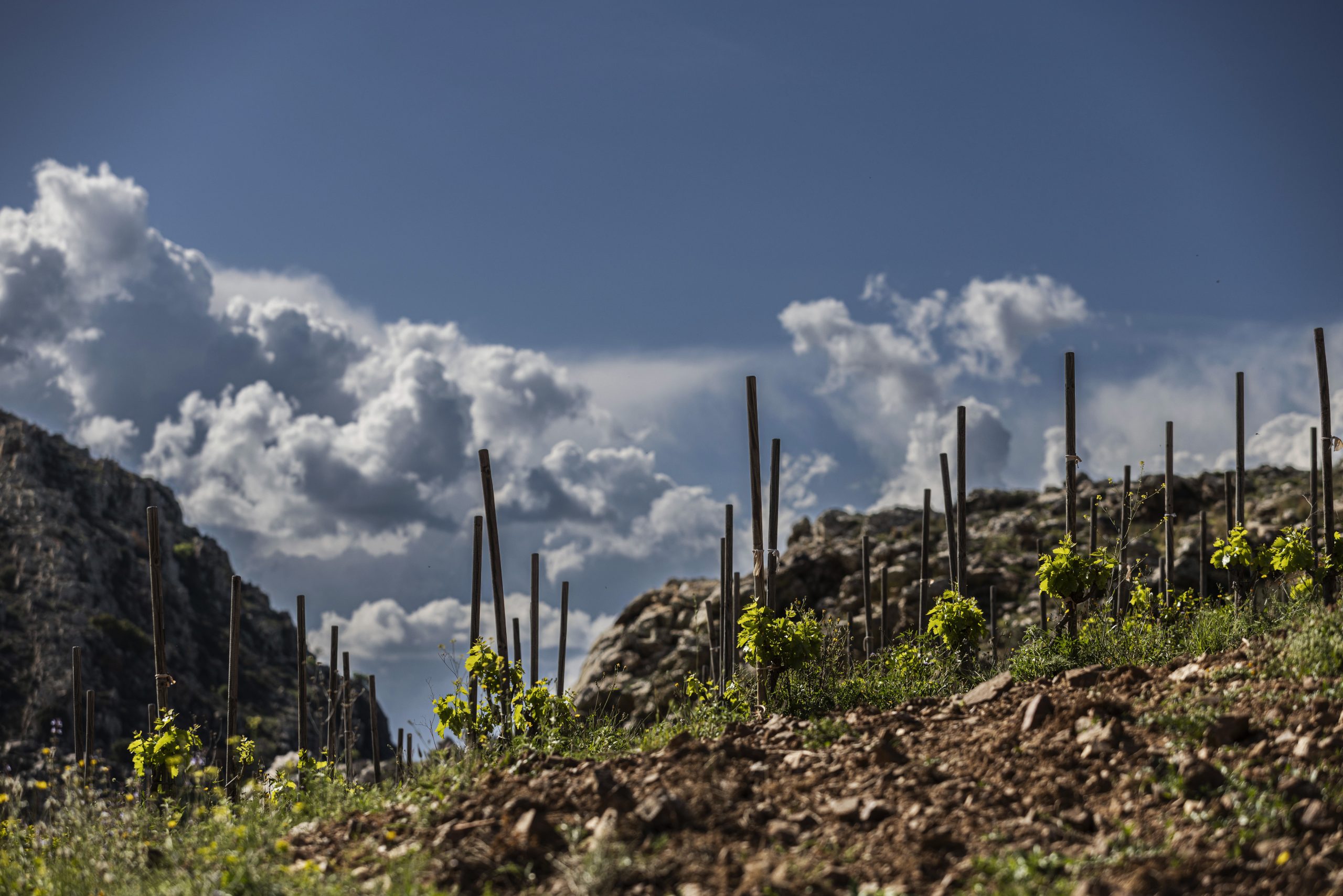
There are books that arrive at just the right moment. Right now, I am rereading The One-Straw Revolution by Masanobu Fukuoka, and I can’t help thinking about it every morning as I walk through the vineyards of Alpartir. As the grapes begin veraison and the harvest looms on the horizon, his words remind me of something we forget all too often: agriculture is not about dominating nature, but about learning to be a part of it. Perhaps that is why this book moves me so deeply. It isn’t just about farming; it’s about a way of looking at the world.
Veraison is one of those moments that never ceases to amaze me. After months of watching the vine grow, observing how each shoot reaches for the light and how the clusters gradually form, the moment arrives when the plant shifts its focus. The berries stop growing and begin to ripen. The Garnacha grapes start to take on pink and purplish hues, the Macabeo loses its intense green, and almost without us noticing, the entire vineyard enters a new stage. It is a silent shift, but for anyone who lives by the vine, it marks the start of a countdown filled with both excitement and uncertainty. The weather can still change everything, and precisely because of that, every walk among the vines becomes slower and more attentive.
In our vineyards in the Sierras del Jalón, veraison is progressing fairly evenly in the lower and mid-altitude Garnacha plots, while the vineyards situated between 900 and 1,000 metres are still home to a significant portion of green clusters. The Macabeo has also clearly begun this process, though visually it is far more subtle. Everything points to a harvest a few days earlier than an average year—a consequence of a particularly hot and dry July—though still far from being as early as vintages like that of 2022.
As I observe this moment in the vineyard, I can’t stop thinking about another idea that runs through Fukuoka’s book: every human intervention in nature carries consequences, often invisible ones, and true knowledge lies in discerning when we must act and when we should simply observe. For decades, we have confused progress with control. We have tried to order, tidy, and produce with greater speed, convinced that nature constantly needed to be corrected. Yet, the more time I spend in the vines, the clearer it becomes that we are not here to impose a balance, but to preserve one that existed long before us.
This summer, devastating fires have been burning once again across Gredos, Cinco Villas, Maestrazgo, and so many other corners of our planet. It is logical to talk about climate change, as it would be absurd to deny its influence, but I believe we often use that explanation to avoid a much more uncomfortable conversation. A fire doesn’t begin only when someone lights a spark or when the wind blows. It begins many years earlier—when farmers disappear, when herds stop grazing, when terraces are abandoned, and when villages lose the people who gave meaning to the landscape. Without management, the countryside ceases to be an inhabited ecosystem and turns into combustible fuel waiting for the wrong day.
Perhaps that is why those of us who have chosen to return to the land carry a responsibility that goes far beyond making wine. When we left a comfortable life to restore old mountain vineyards in Alpartir, we weren’t looking to construct a romantic narrative. We did it because we believed those vines still had something to say, and because we sensed that the future of the rural world didn’t depend solely on subsidies, social media posts, or speeches, but on people willing to restore activity, knowledge, and dignity to a territory. Over time, I’ve come to understand that a well-tended vineyard is far more than an agricultural operation: it is biodiversity, it is landscape, it is culture, and it is also a firebreak. As María José López de Heredia has said to me in the past, a viticultural project entails so much more than just the resulting wine.
Sometimes I think that true luxury is not drinking a great wine, but the fact that there are still people dedicated to caring for the places where those wines are born. Every bunch that changes colour in our vineyards today is the result of many small decisions made throughout the year, but also of one far more important decision: to not give up. At a time when everything seems to urge us toward the cities, continuing to believe in a small village like Alpartir might seem like madness. Yet, perhaps that very faith is what we need to rebuild the balance we have lost.
Fukuoka wrote that the revolution could start with a single blade of straw. I like to think that here, on the slopes of Alpartir, that same revolution can also begin with an old Garnacha vine, a farmer who chooses to stay, and a landscape that once again has someone to care for it.